
 TR
 EN
 RU
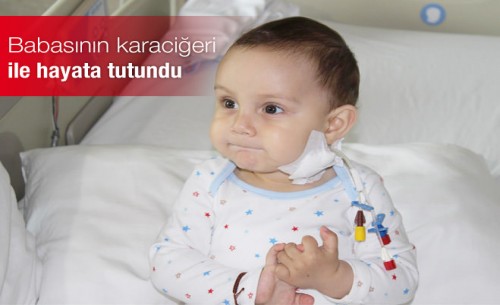
Ata Mert
In İzmir, little Ata Mert Aşık, whose jaundice continued even though 2 months had passed since his birth, was found to have been born without bile ducts and was diagnosed with ‘biliary atresia’. After the ‘Kasai operation’, a temporary procedure to buy time for him to grow, little Ata Mert, at 14 months old, held on to life when a part of the liver of his father, Murat Aşık, was transplanted. While father and son recovered and were discharged, his 36-year-old mother Sibel Aşık said, “Our son has started a new life.”
Ata Mert, the second child of Sibel Aşık and pharmacy technician Murat Aşık, who live in Narlıdere and have a 5-year-old son named Ömer Ege, was born on 16 February 2014. As in many newborn babies, jaundice began in little Ata Mert too. But Ata Mert’s jaundice did not go away and the process dragged on. The Aşıks took Ata Mert to the doctor, and once even to an endocrinology specialist. This specialist’s answer to the family was, “There is nothing wrong with him, why did you bring him to me?” A few days after receiving this answer, little Ata Mert became an emergency case. Tests showed that Ata Mert had been born without bile ducts, and a Kasai operation was recommended for the baby, who was diagnosed with ‘biliary atresia’. Ata Mert, who had been told at 55 days old that there was nothing wrong with him, went under the knife at 64 days old and had the Kasai operation, a temporary procedure to buy time for him to grow. While the Aşıks applied to İzmir Kent Hospital for a transplant, a special programme was started for Ata Mert to gain weight and grow until the transplant. Exactly one year after the Kasai operation on 21 April 2014, when he had reached 10 kilos, the inevitable end came quickly for Ata Mert. Blood was seen in his vomit, and it was determined that variceal bleeding had begun in his oesophagus. When it was established that his father Murat Aşık could be the donor, the transplant was set in motion. On 21 April, father and son were taken into the transplant operation by the team made up of Assoc. Prof. Dr. Murat Kılıç, Assoc. Prof. Dr. Murat Zeytunlu, Prof. Dr. Mehmet Alper, Prof. Dr. Çiğdem Arıkan, Op. Dr. Cahit Yılmaz, Op. Dr. Zafer Önen and Op. Dr. Rasim Farajov. After the successful operation, first the father, Aşık, and then Ata Mert were discharged.
Assoc. Prof. Dr. Kılıç said that, as in Ata Mert’s case, the absence of bile ducts is one of the leading reasons that take babies to transplantation, adding, “The treatment of this disease is liver transplantation. Being able to perform transplants even on very small babies saves lives. Ata Mert and his father are doing very well after the transplant.” Father Aşık, who said he had begun to love his little son by calling him “my liver” even before the transplant, said, “The very bad days are behind us. I feel the happiness and peace of having been able to give life to my son. He was my dear one, he became my dear liver.” Mother Sibel Aşık said she saw the developments as “a bad dream” and added, “We came from jaundice to a liver transplant, like a nightmare. Being told that you may lose your child is the most painful thing parents can hear. We lived through this, but our son has started a new life. Both my husband and my son are well, what more could I ask of God. Many thanks to our doctors, too.” Ata Mert, who recovered after the transplant and spread smiles around him and blew kisses with his hand, became the sweetheart of the liver transplant ward, and the picture of happiness painted by his mother Sibel and father Murat Aşık before their discharge was well worth seeing.
…held on to life, 36-year-old mother Sibel Aşık said, “Our son has started a new life.”
