
 TR
 EN
 RU
Bypass and Liver in the Same Session
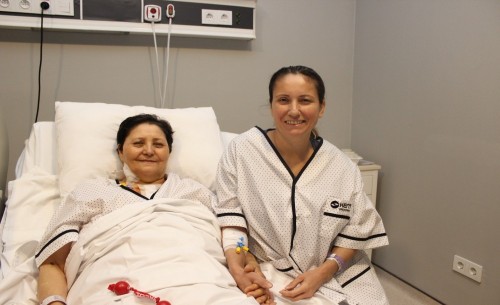
Ferdane Alır (66), who was admitted to hospital for a liver transplant because of both cirrhosis and cancer and was found to be at risk for her heart health, was relieved of two ailments at once thanks to the cooperation of surgeons. In the same session, Alır first had bypass surgery on three blocked vessels while her heart was beating, and then received a piece of liver taken from her daughter Filiz Çam (46). Prof. Dr. Murat Kılıç said, “For the patient, it was essential that the two major operations be performed one after the other. It turned out to be a successful example of teamwork.”
Ferdane Alır (66), who was admitted to hospital for a liver transplant because of both cirrhosis and cancer and was found to be at risk for her heart health, was relieved of two ailments at once thanks to the cooperation of surgeons. In the same session, Alır first had bypass surgery on three blocked vessels while her heart was beating, and then received a piece of liver taken from her daughter Filiz Çam (46). Prof. Dr. Murat Kılıç said, “For the patient, it was essential that the two major operations be performed one after the other. It turned out to be a successful example of teamwork.”
Ferdane Alır, 66, who lives in Çanakkale and has 2 children and 4 grandchildren, had surgery on her uterus 8 years ago. Tests carried out 9 months after the operation showed fatty liver, and Alır kept up her check-ups without fail. An MRI taken last February then showed a mass in her liver. It emerged that fatty liver not related to alcohol use (NASH – non-alcoholic steatohepatitis) had progressed to cirrhosis and that liver cancer had developed on this basis. Alır then applied to a university hospital in İzmir, and because of the pandemic she came for treatment in June. While the mass in her liver was burned (ablated) by an interventional method, she was told that she needed a liver transplant to regain her health. Last September she applied to Kent Hospital for a transplant; tests showed that her daughter could be the donor, but serious narrowing was found in three of the main vessels of the heart. Told that her heart condition would pose a risk for the liver transplant, Alır underwent angiography in Çanakkale, but the blockage in her heart vessels could not be opened. She then came to Kent Hospital in İzmir again and was told that she needed a bypass, but that doing one of the two operations first and the other later would pose a life-threatening risk. The liver transplant team and the cardiovascular surgeons therefore evaluated the patient together and decided to perform the bypass first and then the transplant in the same session. Ferdane Alır accepted the doctors’ recommendation and went on the operating table on 14 January. After an operation lasting 9 hours in total, including 3 bypasses, a new life began for Ferdane Alır.
Bypass performed on a beating heart
Assoc. Prof. Dr. Cüneyt Narin, the cardiovascular surgeon at Kent Hospital who replaced three of Ferdane Alır’s vessels before the transplant, said, “Bypass operations are usually performed with the heart stopped. However, bearing in mind the liver transplant to follow, and thinking that it could increase both the risk of bleeding and the problem of organ failure, we performed the bypass on a beating heart, without stopping it. Such patients are rarely seen, and these operations are rarely performed.”
Cirrhosis and liver cancer due to NASH
Prof. Dr. Murat Kılıç, founding head of the Liver Transplantation and Hepatobiliary Surgery Department at İzmir Kent Hospital, said the following about the transplant performed by his team, made up of Op. Dr. Cahit Yılmaz, Op. Dr. Kamil Kılıç, Op. Dr. Rasim Farajov and Op. Dr. Zaza Iakobadze, and about NASH:
“Ferdane Alır was a patient with liver cirrhosis due to NASH and early-stage liver cancer that had developed on this basis. The tests revealed problems with her heart. Without heart surgery first, a liver transplant would have been very risky; and if we left the liver transplant until after the heart surgery, it would not have been possible for the patient to get through the convalescence after the heart surgery with a cirrhotic liver. That is why consecutive operations in the same session were chosen. Another important point here is NASH. When fatty liver occurs together with inflammation, it is called NASH. NASH has nothing to do with alcohol consumption. Apart from alcohol, conditions such as diabetes, insulin resistance and obesity make the liver fatty; if left untreated, it causes cirrhosis just like alcohol-related fatty liver, and cirrhosis can only be treated by liver transplantation. That is why fatty liver should not be taken lightly.”
“I thought I was perfectly healthy”
Ferdane Alır, who describes herself as a healthy person who never skipped her doctor check-ups, said, “When the doctor called me for a check-up, I would go whatever the time of day. When I was told I had fatty liver, I would go on a diet and lose weight. At the next check-up I would be told that everything was fine. It never crossed my mind that it would come to this. I thought I was perfectly healthy. It was a surprise that my heart caused trouble, too. For the last two years I had had severe pain after walking. I couldn’t take a step. After resting a little, I could walk again. As it turned out, this was related to the heart as well. Fortunately, in safe hands, my daughter gave me new life and my doctors kept me alive. Bless them, may they live long.”
Filiz Çam, noting that her mother went through two major operations in the same session, said, “The surgery was very risky. I tried to talk my mother out of it, and she told me, ‘I would rather stay on the table than wait for death.’ Everything went well; I am very happy to have been a lifeline for my mother.” Ferdane Alır (66), who was admitted to hospital for a liver transplant because of both cirrhosis and cancer and was found to be at risk for her heart health, was relieved of two ailments at once thanks to the cooperation of surgeons. In the same session, Alır first had bypass surgery on three blocked vessels while her heart was beating, and then received a piece of liver taken from her daughter Filiz Çam (46). Prof. Dr. Murat Kılıç said, “For the patient, it was essential that the two major operations be performed one after the other. It turned out to be a successful example of teamwork.”
Ferdane Alır, 66, who lives in Çanakkale and has 2 children and 4 grandchildren, had surgery on her uterus 8 years ago. Tests carried out 9 months after the operation showed fatty liver, and Alır kept up her check-ups without fail. An MRI taken last February then showed a mass in her liver. It emerged that fatty liver not related to alcohol use (NASH – non-alcoholic steatohepatitis) had progressed to cirrhosis and that liver cancer had developed on this basis. Alır then applied to a university hospital in İzmir, and because of the pandemic she came for treatment in June. While the mass in her liver was burned (ablated) by an interventional method, she was told that she needed a liver transplant to regain her health. Last September she applied to Kent Hospital for a transplant; tests showed that her daughter could be the donor, but serious narrowing was found in three of the main vessels of the heart. Told that her heart condition would pose a risk for the liver transplant, Alır underwent angiography in Çanakkale, but the blockage in her heart vessels could not be opened. She then came to Kent Hospital in İzmir again and was told that she needed a bypass, but that doing one of the two operations first and the other later would pose a life-threatening risk. The liver transplant team and the cardiovascular surgeons therefore evaluated the patient together and decided to perform the bypass first and then the transplant in the same session. Ferdane Alır accepted the doctors’ recommendation and went on the operating table on 14 January. After an operation lasting 9 hours in total, including 3 bypasses, a new life began for Ferdane Alır.
Bypass performed on a beating heart
Assoc. Prof. Dr. Cüneyt Narin, the cardiovascular surgeon at Kent Hospital who replaced three of Ferdane Alır’s vessels before the transplant, said, “Bypass operations are usually performed with the heart stopped. However, bearing in mind the liver transplant to follow, and thinking that it could increase both the risk of bleeding and the problem of organ failure, we performed the bypass on a beating heart, without stopping it. Such patients are rarely seen, and these operations are rarely performed.”
Cirrhosis and liver cancer due to NASH
Prof. Dr. Murat Kılıç, founding head of the Liver Transplantation and Hepatobiliary Surgery Department at İzmir Kent Hospital, said the following about the transplant performed by his team, made up of Op. Dr. Cahit Yılmaz, Op. Dr. Kamil Kılıç, Op. Dr. Rasim Farajov and Op. Dr. Zaza Iakobadze, and about NASH:
“Ferdane Alır was a patient with liver cirrhosis due to NASH and early-stage liver cancer that had developed on this basis. The tests revealed problems with her heart. Without heart surgery first, a liver transplant would have been very risky; and if we left the liver transplant until after the heart surgery, it would not have been possible for the patient to get through the convalescence after the heart surgery with a cirrhotic liver. That is why consecutive operations in the same session were chosen. Another important point here is NASH. When fatty liver occurs together with inflammation, it is called NASH. NASH has nothing to do with alcohol consumption. Apart from alcohol, conditions such as diabetes, insulin resistance and obesity make the liver fatty; if left untreated, it causes cirrhosis just like alcohol-related fatty liver, and cirrhosis can only be treated by liver transplantation. That is why fatty liver should not be taken lightly.”
“I thought I was perfectly healthy”
Ferdane Alır, who describes herself as a healthy person who never skipped her doctor check-ups, said, “When the doctor called me for a check-up, I would go whatever the time of day. When I was told I had fatty liver, I would go on a diet and lose weight. At the next check-up I would be told that everything was fine. It never crossed my mind that it would come to this. I thought I was perfectly healthy. It was a surprise that my heart caused trouble, too. For the last two years I had had severe pain after walking. I couldn’t take a step. After resting a little, I could walk again. As it turned out, this was related to the heart as well. Fortunately, in safe hands, my daughter gave me new life and my doctors kept me alive. Bless them, may they live long.”
Filiz Çam, noting that her mother went through two major operations in the same session, said, “The surgery was very risky. I tried to talk my mother out of it, and she told me, ‘I would rather stay on the table than wait for death.’ Everything went well; I am very happy to have been a lifeline for my mother.”
