
 TR
 EN
 RU
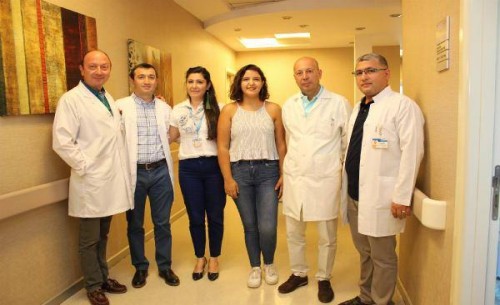
The Miracle Girl Is Now a Healthcare Worker
Handan Ülker (23), who was regarded as a miracle for surviving after being born without bile ducts and who had a liver transplant 6 years ago at the age of 17, graduated from university as a physiotherapist. The young woman, who received her diploma and began looking for a job, said: “I had a childhood and adolescence spent constantly in hospital, but it ended happily. People whose childhoods were like mine may run away from hospitals, but I, on the contrary, chose this profession in order to be at patients' side. I want to start my career as soon as possible.”
Handan, the youngest of the 3 children of Nezahat Ülker, a housewife in Antalya, and Ramazan Ülker, a retired car mechanic, was born on 28 December 1996. When she was only a few days old, Handan was diagnosed with biliary atresia (absence of the bile ducts). At 2.5 months old, Handan underwent the bile duct operation known as the Kasai procedure. Despite this operation, however, she had to stay in hospital for an average of 10 days every month. Handan, who had stomach bleeding 4 to 5 times, was put on the deceased-donor list at Akdeniz University Hospital, where she was being treated, because no suitable donor was found in her family. In 2012 she was referred to İzmir Kent Hospital for a liver transplant. Handan, who shuttled between İzmir and Antalya and spent her infancy and childhood in hospitals, continued her education at the same time. Handan, one of the few patients in the world who are in the medical literature as having lived to the age of 17 after being born without bile ducts and having had this operation, had a suitable liver found for her from a deceased donor on 10 February 2013. Called to Kent Hospital for the transplant, Handan was taken into surgery by the team led by Assoc. Prof. Dr. Murat Kılıç and Op. Dr. Cahit Yılmaz.
After staying in İzmir for a while following the transplant and returning to her hometown, Handan threw herself into her studies to fulfil her dreams. She won a place in the physiotherapy department of a foundation university in İzmir. Her enrolment was later transferred to the Department of Physiotherapy and Rehabilitation, Faculty of Health Sciences, at Nuh Naci Yazgan University in Kayseri, and Handan studied at Dokuz Eylül University as a visiting student.
Handan, whose childhood was spent in hospitals and who began a new life with a liver transplant, also made her dream of becoming a healthcare worker come true. Now a physiotherapist, Handan took her diploma in hand, shared her excitement with her young colleagues at the hospital where she had her transplant, and took part in therapy sessions.
‘INSTEAD OF RUNNING AWAY FROM HOSPITALS, I CHOSE TO BE WITH PATIENTS’
Noting that she had started looking for a job so that she could begin her profession as soon as possible, Handan Ülker described her feelings as follows:
“I was born with congenital absence of the bile ducts. I have been in hospital since I was born. Apparently I was out of hospital only during the first week after birth, and that was the period when the symptoms of the disease had begun to show. I had a liver transplant at the age of 17. I am one of the rare people who were born with this disease and managed to live until 17. While the life expectancy the doctors gave was 11–12 years, I lived until 17 and then had the transplant. It was a very difficult process. I had a childhood and adolescence spent constantly in hospital, but it ended happily. I had the transplant 6 years ago and I am well now. The biggest reason I managed this was my family. With the motivation and happiness my family gave me, I fought this disease until I was 17. I had a childhood in which I was aware of everything. I was aware of how serious my condition was. In this process I even lost childhood friends. They were not as lucky as I was. I was waiting for an organ, and I was hopeful that one would come. Perhaps that is what kept me going. I always felt very mature compared with people my age. I had to be strong. While I was being treated at Akdeniz University, we came to Kent Hospital a year before my operation. The process sped up here, because my condition had by then become very serious. The organ of a person my age, who had died in a traffic accident, was transplanted to me, and it became hope and life for me.”
Handan, who noted that after the transplant she studied at home for half a term and then returned to Antalya, said: “I moved to another high school so that I would be closer to home. My school life was hard. I am very happy with where I am now. I chose the healthcare sector. I have been inside hospitals since I was born. People whose childhoods were spent in hospital may run away from hospitals, but I, on the contrary, because I know the situations of the patients in hospital well, wanted to spend more time in the hospital and wanted to be at patients' side. I am happy that I chose this profession. I am currently looking for a job in İzmir.”
Assoc. Prof. Dr. Murat Kılıç of the İzmir Kent Hospital Liver Transplantation team also gave the following information:
“Biliary atresia quickly causes liver cirrhosis and failure, and if liver transplantation is not carried out, it leads to the loss of the baby. Handan's liver held out until the age of 17 after her first operation. She was able to wait until 17 without a transplant, but patients who can live to this age without a transplant are seen very rarely. Biliary atresia patients who reach their 20s are very few in number. Handan is one of those patients. Even if late, she regained her health and her body adapted to the organ. We have been following her for 6 years. She herself chose the healthcare sector. A patient joining the army of healthcare workers has been a good example.”
