
 TR
 EN
 RU
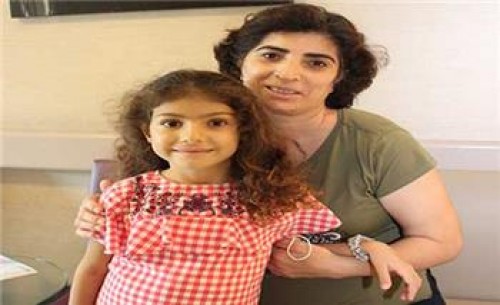
Nur Melek Kaymaz
Nur Melek, who was found to have developed cirrhosis due to Wilson’s disease (copper accumulation in the liver) after fluid built up in her abdomen, was taken to the operating table following an emergency transplant decision. While Nur Melek was given a new lease on life through a liver transplant from her mother Nursel Kaymaz (44), Op. Dr. Cahit Yılmaz said, “When we took Nur Melek into surgery, her jaundice value, whose upper limit is 1, was 58. After the transplant she regained her health.”
The lottery of Wilson’s disease, which is seen in one in 60,000 people and is among the top 10 conditions that lead children to liver transplantation, this time struck 5-year-old Nur Melek. The youngest of the three children of Nursel Kaymaz, a municipal civil servant, and Yaşar Kaymaz, a retired non-commissioned officer, who live in the Söke district of Aydın, Nur Melek gave the first signs of her illness 1.5 years ago when she “started eating soil.” However, while her doting mother and father kept searching for a cure, mostly through drug treatments for a diagnosis of “anemia,” the onset of vomiting increased their worries. The little girl, who was being treated for anemia and a urinary tract infection, got worse last July. At Aydın Children’s Hospital and then at Adnan Menderes University Hospital, where they went next, the rise in her liver values was found suspicious, and Nur Melek was referred to Ege University Hospital. Jaundice began and acute liver failure was detected, and an emergency transplant decision was made for Nur Melek. As she began to lose consciousness, Nur Melek was referred to İzmir Kent Hospital for a liver transplant. Her health worsening day by day, Nur Melek had her liver transplant on 2 August, the day after she arrived at Kent. The liver tissue taken from her mother Kaymaz was transplanted into Nur Melek by a team made up of Assoc. Prof. Dr. Murat Kılıç, Op. Dr. Cahit Yılmaz, Op. Dr. Kamil Kılıç, Op. Dr. Rasim Farajov and Op. Dr. Zaza Iakobadze. Mother and daughter, who recovered quickly after the transplant, were discharged.
Kaymaz, the mother who gave her daughter the gift of life, said: “I would give my life for my daughter. While we were worried about my daughter’s health, we were faced with a disease that leads to liver transplantation. We heard its name for the first time; fortunately, we have left the bad days behind. My daughter has been born again. We thank everyone who helped us reach this day.” The father, Kaymaz, who said that when they brought their daughter to Kent Hospital her condition was very bad and they lived in fear that she could slip away from them at any moment, said: “1.5 years ago we noticed my daughter was eating soil. They say this can happen with anemia too. She was treated for anemia. Vomiting and nausea began, and we struggled to get treatment for it. Last July she gained 2.5 kilos in 20 days. Fluid had collected in her abdomen. That was when we started to be even more afraid. It turned out that this process stemmed from a disease called Wilson, whose name we heard for the first time. The process that began on 21 July and was dragging my daughter toward death ended with the transplant on 2 August. The disease turns out to be genetic. My wife and I are not related. Blood was taken at Ege for a genetic test and we are waiting for the result. What matters now is that my daughter is well. We thank all our doctors very much; they saved my daughter’s life.”
Meanwhile, Op. Dr. Cahit Yılmaz from the Kent Hospital Liver Transplantation team gave the following information about Nur Melek’s condition:
“During Nur Melek’s follow-up at Ege University Hospital, both her liver functions and her general condition kept deteriorating, and on the evening of 1 August she came to our hospital in a pre-coma state. When we admitted the patient, she was drowsy and about to lose consciousness, and her jaundice value, whose upper limit is 1, was 58. We quickly examined her mother as a donor, and since she was suitable, we performed the transplant from her mother the next day. The hospital course after the operation was uneventful; her liver functions and general condition improved. The patient’s follow-up continues on an outpatient basis and the process is proceeding as expected.”
