
 TR
 EN
 RU
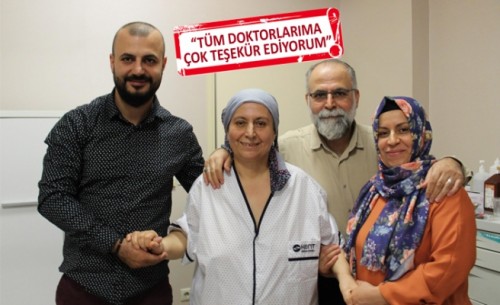
Mürvet Aydın
Regained her health through two operations performed in a single session
Mürvet Aydın, 53, who lives in İZMİR, was operated on simultaneously by two separate teams in a single session at Kent Hospital. Prof. Dr. Cem Terzi, noting that such patients are not operated on because of the high risk, said: “As two separate teams, we first cleared the liver tumours and then the tumours of the peritoneum, and the final tumour-destroying procedure was carried out with hot chemotherapy (HIPEC). We performed the 2 major operations that gave our patient a chance at life simultaneously in a single session.”
Mürvet Aydın, who has four children and 7 grandchildren, was diagnosed with uterine cancer in 2017. Aydın, whose uterus and ovaries were removed because of the tumour, received 6 courses of chemotherapy. About 9 months after this treatment, Aydın, who was also obliged to have an umbilical hernia operation, returned to her normal life. However, when the abdominal pains she had from time to time became severe again, she went back to the hospital. Tests revealed metastases in the liver and numerous tumours in the peritoneum. Aydın, who was evaluated at the Kent Oncology Center by Prof. Dr. Cem Terzi, was scheduled for an operation. The operation was first begun by the liver surgery team: Assoc. Prof. Dr. Murat Kılıç, Op. Dr. Cahit Yılmaz, Op. Dr. Rasim Farajov and Op. Dr. Zaza Iakobadze. After the removal of a total of 6 metastatic lesions, the largest of which were 3 and 2 centimetres in diameter, the team made up of Prof. Dr. Cem Terzi, Prof. Dr. Coşan Terek and Op. Dr. Mustafa Göztok took over the operation.
Prof. Dr. Terzi, noting that the patient, in whom peritoneal carcinomatosis (spread to the peritoneum) and numerous metastatic lesions in the liver were found, was in the high-risk group, gave the following information about the operation, which lasted a total of 11.5 hours:
“In our patient, who had a history of cancer two years earlier and had no very significant complaints, check-ups revealed a mass inside the abdomen, cancer that had spread to the peritoneum and invaded the bowel, and metastasis in the liver. Such cases are rarely seen. With metastasis in the liver as well, it can be said that the patient could not be operated on at all, because of risks such as that this tumour could not be removed and that the patient would not withstand two operations. The literature states that it is risky if the number of metastases is more than 3, and surgery is not recommended. So patients in this condition are generally not operated on because of the high risk. Advances in liver surgery make the operation possible by removing the metastases without taking out a large piece and without causing liver failure. This was not an operation that a single team could perform. First the liver surgery team cleared the metastases in the liver, then we took over the operation. The cancer that had spread inside the abdomen and to the peritoneum was cleared. We removed the entire colon affected by cancer, and the spleen. We stripped the peritoneum. Afterwards, we applied HIPEC, which we call hot chemotherapy. For 90 minutes, at a temperature of 42 degrees, with a new device of advanced technology (with carbon dioxide agitation), we applied a certain pressure inside the abdomen and delivered chemotherapy into the patient's abdomen. Our patient, who spent one night in intensive care, was discharged a week later.”
