 TR
 EN
 RU
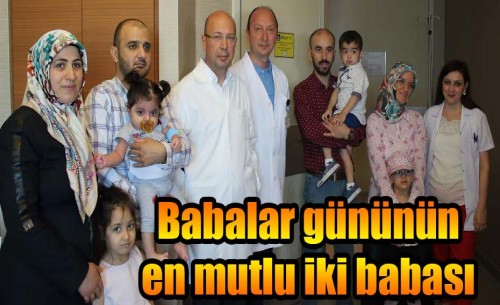
The Happiest Fathers
The two happiest fathers on Father’s Day: one became a donor for his 7-month-old daughter, the other for his 2-year-old son, and through liver transplants they saved their children’s lives
In İzmir, Yavuz İnan (33) became a donor for his 7-month-old daughter Serra and Şenol Kiraz (31) for his 2-year-old son Ensar, bringing their children back to life through liver transplants. While İnan and Kiraz said that a smile from their children is the most beautiful gift, they also became the two happiest fathers of this Father’s Day. Assoc. Prof. Dr. Murat Kılıç said: “Of our 278 infant and child transplants, in 78 fathers saved their children’s lives as donors.”
REFERRED BY AMBULANCE PLANE
Nurse Meryem Kiraz (28) and ambulance technician Şenol Kiraz (31), who live in Rize, welcomed their second child Ensar into their arms on 14 November 2014. When Ensar, who had grown up healthy until the age of two, began to turn yellow, his parents, who both work in healthcare, took him to a doctor. Ensar, who was sent from Rize to Trabzon, was diagnosed with autoimmune hepatitis. When Ensar became seriously ill, he was referred by air ambulance to Kent Hospital in İzmir. A decision to transplant was made, his father Şenol Kiraz became the donor, and 3 months ago, on 14 March, Medicine Day, the transplant was carried out by the team led by Assoc. Prof. Dr. Murat Kılıç and Op. Dr. Cahit Yılmaz.
FROM JAUNDICE TO LIVER TRANSPLANTATION
Serra, the second child of Yavuz İnan (33), a lathe operator in Manisa, and homemaker Emel İnan (30), was born on 22 June 2016. The İnan couple, who faced a jaundice problem they had not experienced with their first child Ebrar (5), took Serra to a university hospital. Serra, who was followed and tested for months, was found to have blocked bile ducts and was diagnosed with cirrhosis. Her health deteriorating rapidly, Serra was brought to İzmir Kent Hospital for a liver transplant. As with Ensar, Serra’s father Yavuz İnan became her donor too. The team led by Assoc. Prof. Dr. Murat Kılıç and Op. Dr. Cahit Yılmaz transplanted the liver tissue taken from the father into the little girl.
HAPPY FATHERS
While the fathers saved both babies’ lives, the families who met their doctors before Father’s Day made for deeply moving moments. Ensar’s father Şenol Kiraz said: “Our son was slipping away from us. There is a world of difference between that day and today. I thank our Ministry of Health, Kent Hospital and its doctors very much. So that we would not lose time, they sent my child to İzmir by air ambulance. From the airport we came to the hospital by ambulance. We had our transplant without paying a single kuruş, and now we are having our check-ups. My son’s recovery is the greatest gift for us. His laughing and talking is worth everything.”
Yavuz İnan, the father who gave the gift of life to his daughter Serra, expressed his feelings as follows:
“We went through a difficult time; Serra was completely yellow and weak. It is enough for a person to see their child healthy and happy, and all the troubles pass. As a father I cannot put my happiness into words; they say ‘only those who have lived it know,’ and that is how it is for me. When you see the smile on her face, the world becomes her father’s. I believe I will have a wonderful Father’s Day.”
78 TRANSPLANTS FROM FATHER TO CHILD HAVE BEEN PERFORMED
Meanwhile, Assoc. Prof. Dr. Murat Kılıç, Head of the Liver Transplantation Department at İzmir Kent Hospital, noting that they had performed liver transplants on 278 babies and children in 8 years, said the following:
“Liver failure in children is a very serious problem, a life-threatening condition. Without a liver transplant, these children can be lost within weeks or months. Because there is no dialysis option for the liver, as there is for kidney failure, a transplant is the only chance. Unfortunately, deceased donations are not sufficient. In 8 years, 278 babies and children had transplants at Kent. Only 18 of them were from deceased donors. We mainly perform living-donor transplants. Mothers come first: 104 mothers and 78 fathers were donors. In both of our children, the fathers were suitable to be donors and saved their children’s lives. They are followed by uncles, aunts, grandmothers and grandfathers. In living-donor transplants, our country ranks first in Europe. These transplants offer a 90 percent chance of survival.”
THE LIVING DONOR BREAKDOWN IS AS FOLLOWS
Kılıç explained the donor breakdown at Kent, the centre in Türkiye where the most infant and child liver transplants are performed, as follows:
Mother: 104, Father: 78, Sibling (older brother/sister): 15
Maternal aunt: 12, Paternal uncle: 10, Maternal uncle: 10
Paternal aunt: 5, Grandfather: 5, Cousin: 5
Aunt by marriage: 3, Maternal grandmother: 2, Paternal grandmother: 2
Ethics committee: 9, Deceased donor: 18
MOTHERS GAVE BIRTH, FATHERS GAVE LIFE
Pediatric gastroenterology specialist Prof. Dr. Sema Aydoğdu, noting that both babies had returned from the brink of death, gave the following information:
“Serra’s illness is related to being born with blocked bile ducts: biliary atresia. Worldwide, it is the condition that most often leads to liver transplants in babies. It ranks first in Türkiye as well. If the diagnosis is delayed, it leads to cirrhosis within two months. Therefore, babies with biliary atresia need to be transplanted very quickly, within roughly the first 6 months; otherwise we lose these babies to liver failure. Serra’s mother brought her into the world, and she is continuing her life with her father’s liver. Ensar, on the other hand, is a child who was completely healthy until the age of two. Suddenly, there is the liver inflammation we call non-A, non-B, non-C hepatitis, whose cause is unknown and which is generally thought to be possibly related to microbes. But something different happened with Ensar: after the transplant, he this time developed bone marrow failure. As a result of the modern treatments we gave, his bone marrow also recovered, and he is now continuing his life with his father’s liver. Both the fathers and the children are healthy and happy.”
